Science Today and in History
Research Projects
 You may choose any topic in InterActions (e.g., see the
list of available topics). You can also choose a different topic, for example tennis or space travel, provided your teacher approves.
Some of the links on the Resources page may be
useful in looking for another topic. You may choose any topic in InterActions (e.g., see the
list of available topics). You can also choose a different topic, for example tennis or space travel, provided your teacher approves.
Some of the links on the Resources page may be
useful in looking for another topic.
Formulate a list of facts based on the chosen topic, draw a picture related to one of the facts, and analyze an aspect of the research in terms of interactions, energy and/or forces. This can be an individual or team effort. Try to make connections between activities done in class and the real world.
Note that even a research topic like Isaac Newton can be analyzed in terms of interactions, energy or forces. Rather than analyzing Newton himself in those terms, you could analyze an aspect of his research. Consider the evidence that led to him to formulate his Three Laws or his theory of gravity, and analyze some of that evidence using
InterActions methods.
See the Science Investigation
template (pdf). Use the Resources page on
this site to get started. Use the Citations
& References guidelines (pdf) when citing your sources.
A couple specific research topics are listed below:
- Global Warming: Present a basic explanation of global warming and some of its consequences in terms of
InterActions ideas. This is a relevant environmental project topic late in the year (after the Conservation Unit).
- Natural Disasters: Earthquakes and tsunamis are also excellent research topics. Present a basic explanation of a significant act of nature through the concepts learned in
InterActions.
 Contemporary Topics in Science Contemporary Topics in Science
Rather than choosing a topic from among those listed above, read interesting
current science articles from newspapers, magazines or on the Internet. The Resources page
on this site has a list of on-line references that should provide you with
a starting place. A great place to start is a site run by the magazines
Science or Scientific American, a museum like San Francisco's
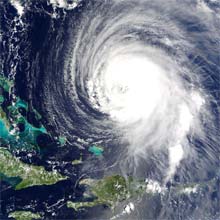
Exploratorium or NASA or JPL. (Photo: Hurricane Isabel;
Credit: Terra Satellite, EOS, NASA)
In addition to following the Science Investigation template for this report or class presentation, you should begin by briefly summarizing the science article and explaining why the reported discovery or finding is important. Then use the student research template to complete your presentation or report, analyzing something in the article in terms of interactions, energy and/or forces.
InterActions Current Events
Read articles or ads in a newspaper or news magazine and determine whether claims made are justified with appropriate evidence.
USA Today is an excellent paper to use for this purpose. For news magazines, you can examine recent issues of
Time or Newsweek. Also, check out science or technology features in your local newspaper.
See the InterActions Current Events activity
sheet.
For this research topic, you may find the following How To.. documents helpful:
 How to analyze an experiment design and determine if the experiment was a fair test How to analyze an experiment design and determine if the experiment was a fair test- How to evaluate an experiment conclusion
- How to evaluate an analysis and explanation
- How to write an analysis and explanation
Note that most of the time, a science or technology article or ad will not describe
an experiment in detail. Also, a lot of scientific knowledge is gained through
careful observations of the natural world, both on Earth and beyond Earth (other
planets, stars, galaxies), in which carefully controlled experiments are impossible
to conduct. As a result, in evaluating the claims made by a newspaper article
or ad, you will need to focus on the evidence provided to back up the claim,
rather than an analysis of experimental design.
|
